On permutation symmetries in Bayesian neural network posteriors: a variational perspective
- Bayesian Deep Learning
- Variational Inference
- Deep Learning Theory
We align independently trained variational neural-network posteriors through neuron permutations and observe low predictive-loss barriers along the resulting distribution interpolations.
Paper NeurIPS 2023
- EURECOM
- Stellantis
Independent variational inference runs can produce Bayesian neural networks with similar predictions and distant weight distributions. We align entire Gaussian weight distributions through neuron permutations, including their uncertainty, before interpolating between them. On MNIST and CIFAR-10, this removes the visible predictive-loss barrier for multilayer perceptrons and substantially reduces it for ResNet-20. Neuron ordering therefore accounts for part of the apparent separation between these variational solutions. A substantial barrier remains on CIFAR-100.
Why neuron ordering changes posterior geometry
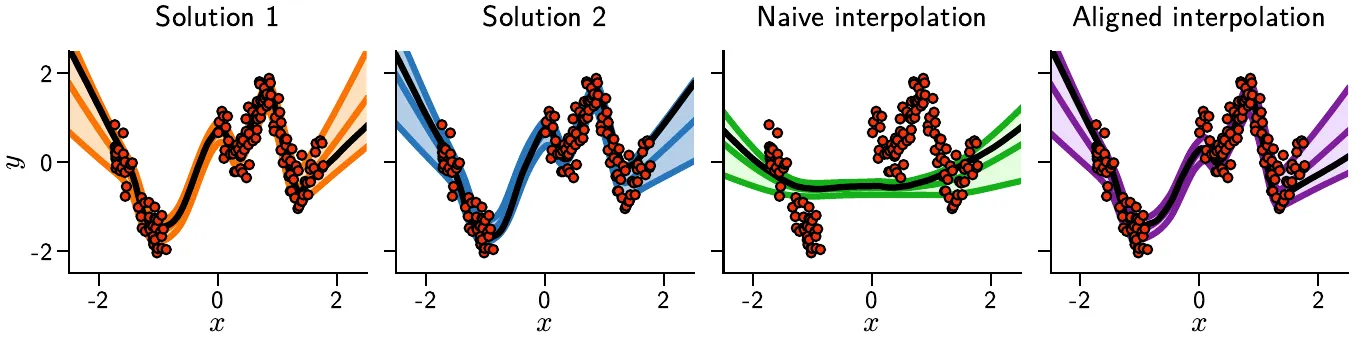
A hidden unit has an arbitrary index. Reordering a layer and compensating in the following layer preserves every network output. For a multilayer perceptron with elementwise activations, a permutation matrix acts on weights and biases as
Applying this transformation to every draw from a weight distribution gives the push-forward distribution . Both distributions induce the same random function. Consequently, comparing independently trained posteriors in their original coordinates can obscure their relationship. We search within this class of equivalent representations for a version of that aligns with .
Interpolating probability mass and measuring predictive quality
For evaluation inputs and labels , we assess each distribution using the marginalized predictive log-likelihood
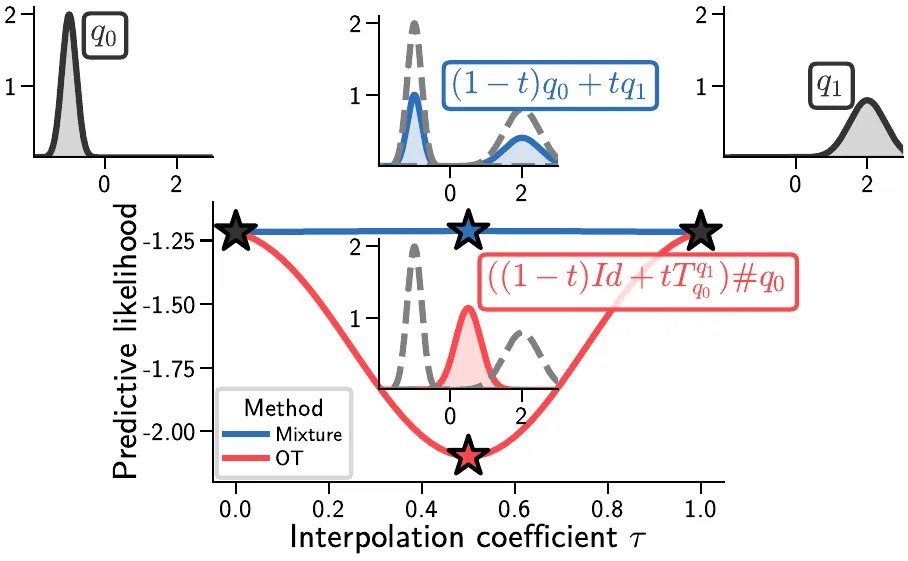
The integral averages predictions over weights before taking the logarithm. We examine how far this score falls below the interpolation of the endpoint scores, equivalently measuring a barrier in negative predictive log-likelihood.
The path should move probability mass through parameter space. We therefore use a Wasserstein geodesic. For diagonal Gaussian endpoints , with means and positive standard-deviation vectors , it becomes
This interpolates means and standard deviations. A mixture instead reweights the endpoints, so its predictions can remain strong while leaving the intervening parameter region unexplored.
Matching means and uncertainty together
For diagonal Gaussians, squared Wasserstein distance reduces to two Euclidean terms:
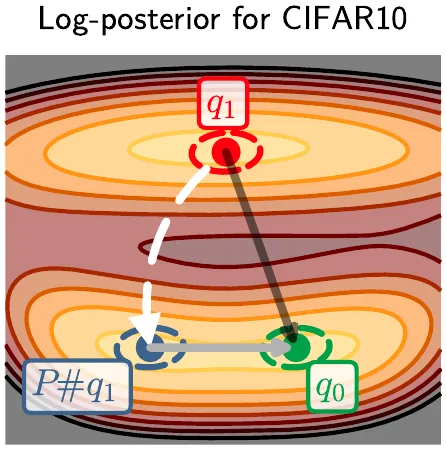
The matching criterion therefore includes the location and spread of each weight distribution. For a single vector, minimizing this expression is a linear assignment problem. In a network, each hidden-layer permutation acts on adjacent weight matrices, coupling their assignments. We alternate between layers, fixing the other permutations and solving the remaining assignment exactly. These updates improve a combinatorial matching objective; the overall search remains a heuristic for the coupled problem. The interpolated path then connects to the aligned endpoint .
Predictive barriers across architectures and training settings
We train independent mean-field Gaussian posteriors by maximizing the evidence lower bound. The classification experiments use MLPs and ResNet-20, Gaussian priors, and filter response normalization for the convolutional networks. They omit data augmentation. Evaluation uses 128 weight samples and 25 evenly spaced interpolation coefficients.
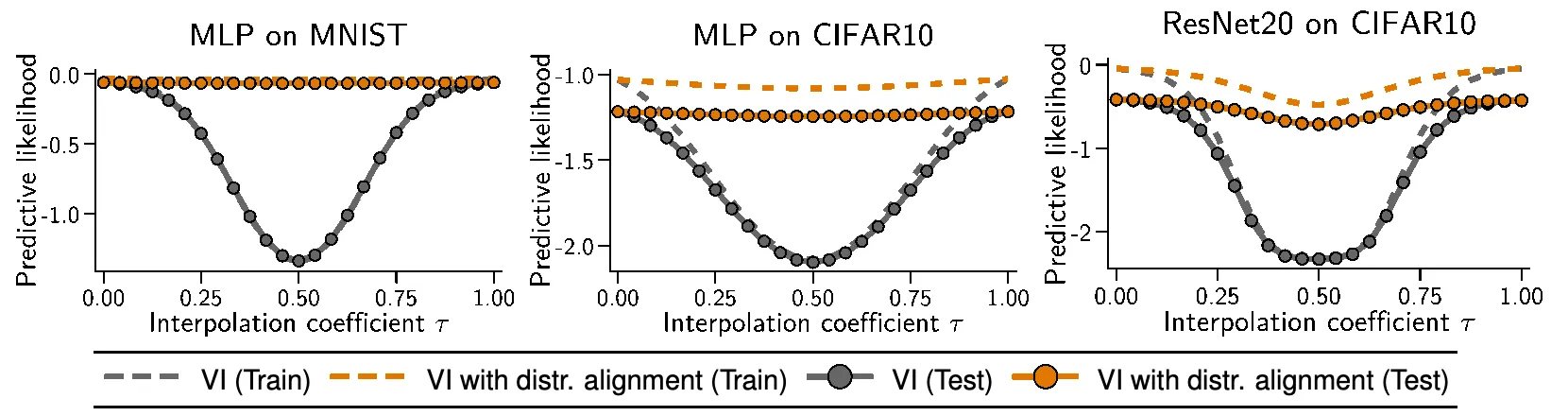
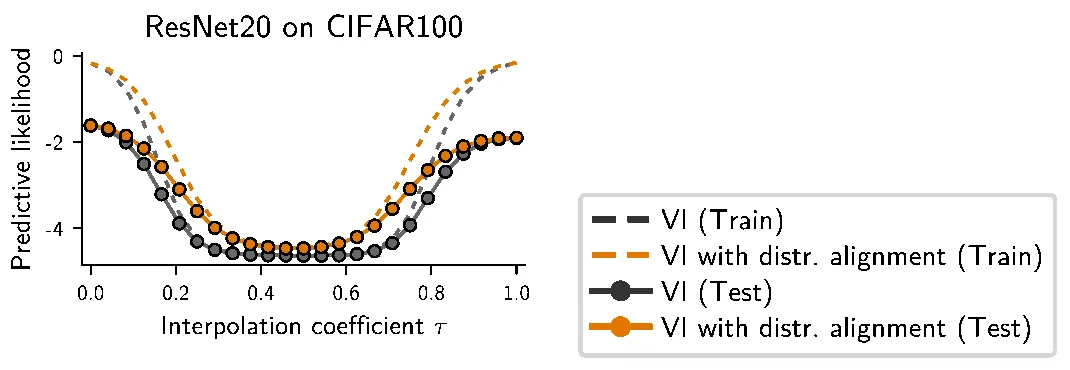
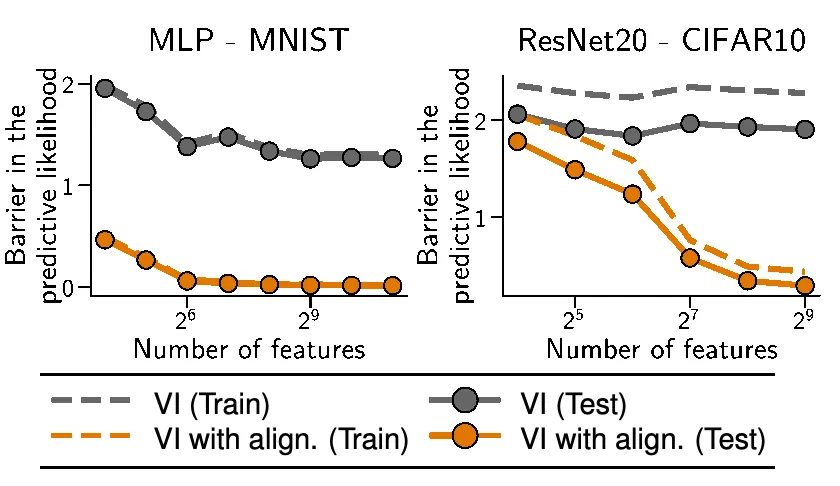
Across these comparisons, alignment substantially improves the full interpolation path on training and test data. Increasing width further reduces aligned barriers. For ResNet-20, the corresponding unaligned barriers remain large, making the interaction between width and neuron correspondence particularly clear.
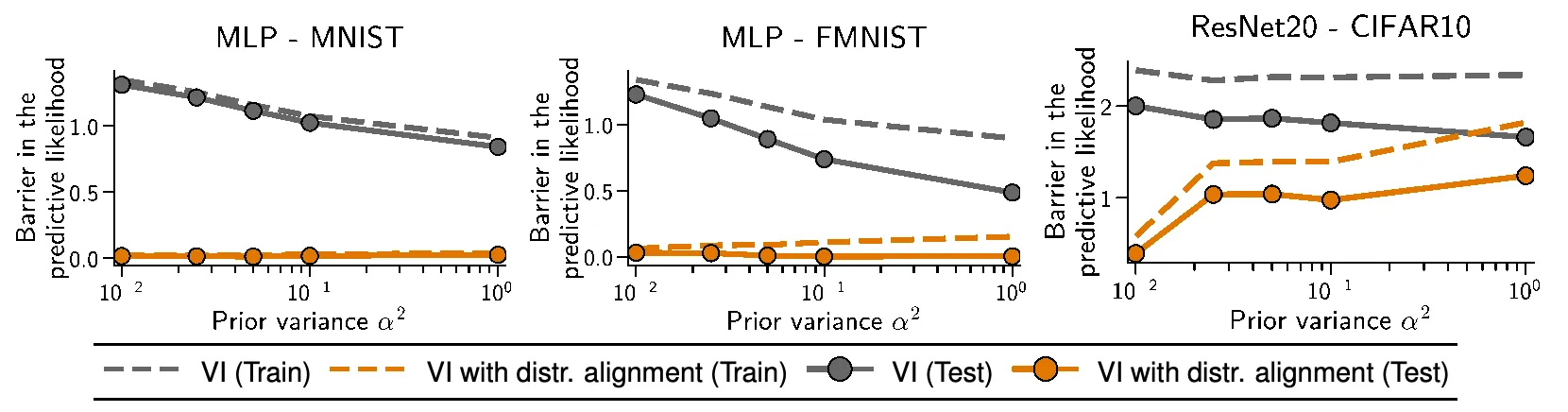
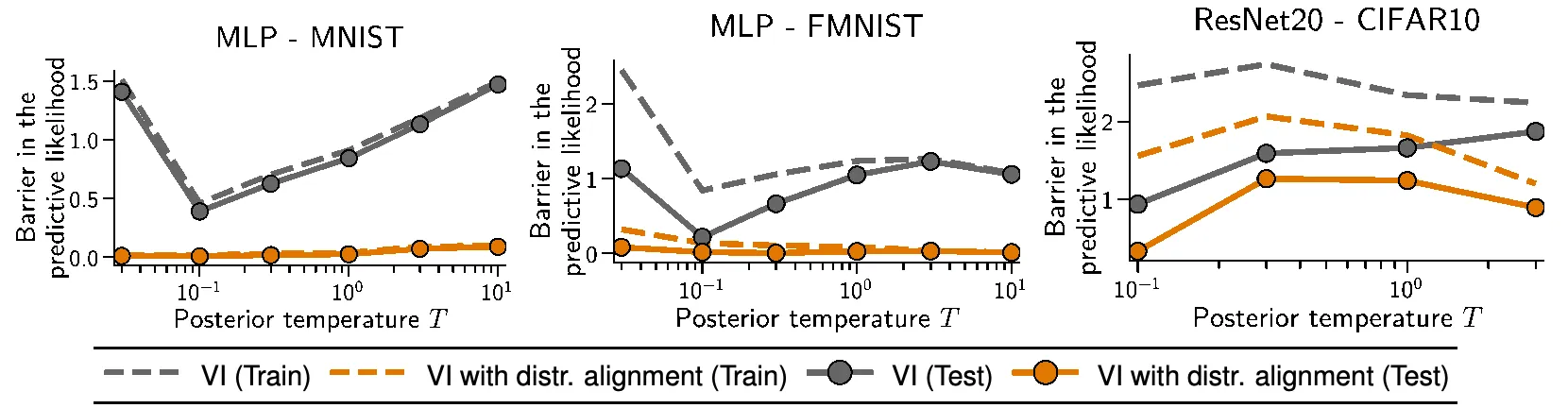
The prior-variance and posterior-temperature sweeps probe the sensitivity of this behavior. Aligned MLP barriers stay close to zero over the tested prior variances, while ResNet-20 retains architecture-dependent residual barriers. A temperature sharpens the posterior target by raising its unnormalized density to the power ; these cold settings can reduce the remaining barrier.
A remaining barrier on CIFAR-100
On CIFAR-100, our matching procedure leaves a large predictive-loss barrier for ResNet-20. The improvement observed on MNIST and CIFAR-10 therefore depends on the task and the permutation found by the layerwise search. The evaluations characterize predictive quality at a finite set of points along paths between mean-field Gaussian approximations.