Class Balanced Dynamic Acquisition for Domain Adaptive Semantic Segmentation using Active Learning
- Computer Vision
Class Balanced Dynamic Acquisition reweights pixel-acquisition scores using observed class counts and shares the annotation budget across images, improving minority-class segmentation on GTAV to Cityscapes.
Paper NeurIPS Workshop on Adaptive Experimental Design and Active Learning in the Real World 2023
- PSL University & Stellantis
- Stellantis
Acquisition scores based on uncertainty and diversity can increasingly favor common classes as the labeling budget grows. We introduce Class Balanced Dynamic Acquisition (CBDA) to allocate pixel labels when adapting a semantic segmentation model from synthetic to real driving scenes. CBDA uses previously acquired class counts to reweight these scores and selects pixels across the target dataset, allowing each image to receive a different budget. On GTAV to Cityscapes, the combination improves both mean and minimum class intersection-over-union (IoU) over the Region Acquisition (RA) baseline, with larger gains at higher budgets.
Why acquiring more labels can increase imbalance
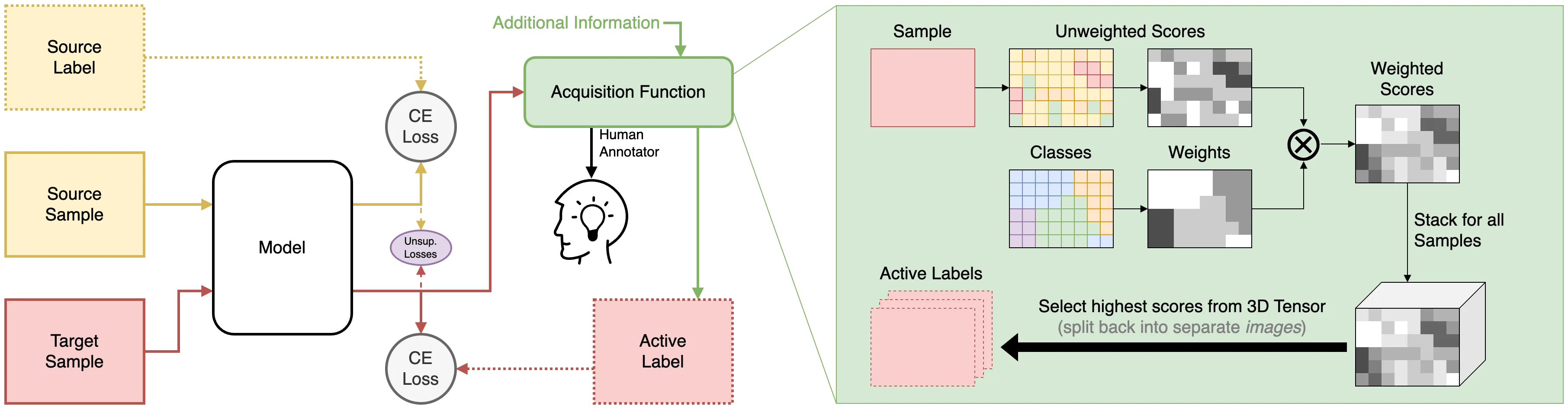
We start with labeled source images and unlabeled target images . Training combines supervised source learning with unsupervised target objectives. At each acquisition round, the model scores target pixels; queried labels then contribute a supervised target loss. Our experiments reveal selected pixels' existing ground-truth labels, simulating an annotator.
The baseline RA allocates the same pixel budget to every target image. In our GTAV experiments, larger budgets produce increasingly imbalanced selections and lower segmentation scores. Rare classes suffer most from this degradation, motivating control over the distribution of acquired labels.
Turning class counts into acquisition weights
At round , let count previously acquired labels of class . For target images of height and width , total labeling fraction , classes, and rounds, we define a uniform cumulative class target and its weight:
A class approaching its target receives a smaller weight. The positive floor , for example , keeps every class eligible and preserves score differences within classes whose targets are filled. The uniform distribution serves as a soft target when the target-domain class frequencies are unknown.
We apply the weight according to the model's predicted class at pixel :
Here is the underlying acquisition score. Counts use acquired labels; prospective queries use predicted classes. Dynamic Acquisition (DA) stacks all weighted maps into a tensor of shape and selects its highest-scoring eligible pixels. This allows an image containing useful minority-class pixels to receive more queries.
Improvements concentrate on minority classes
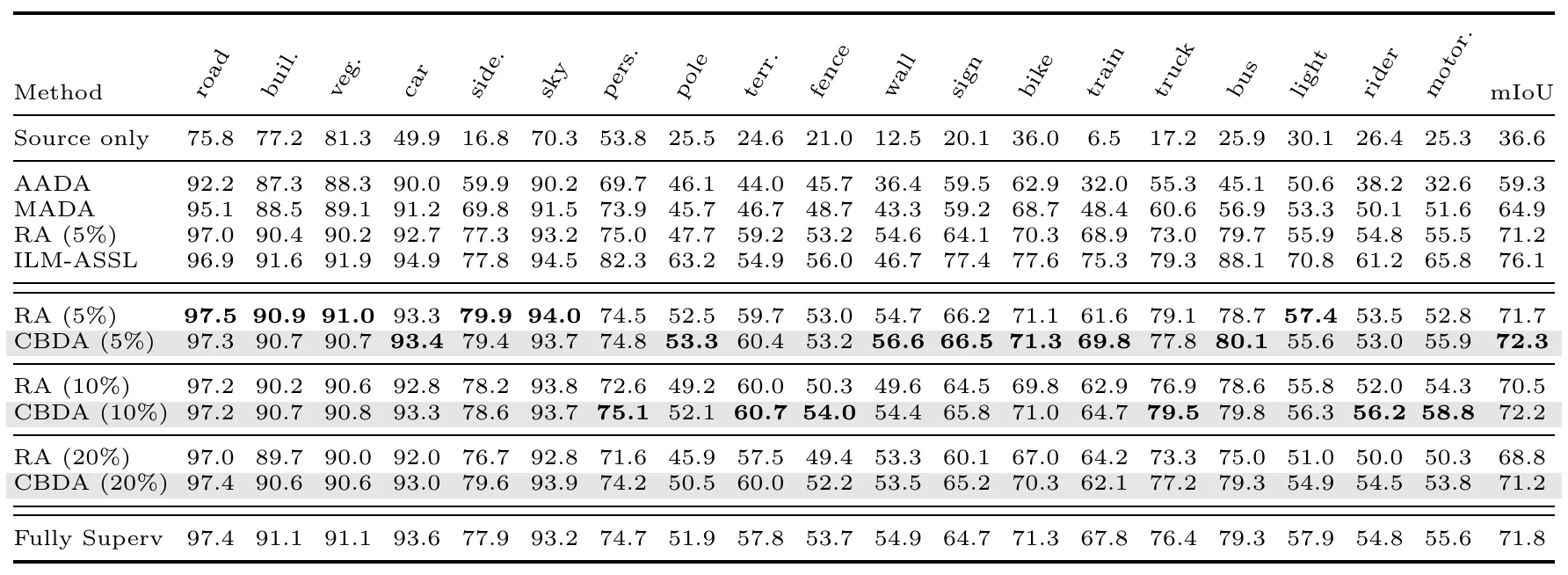
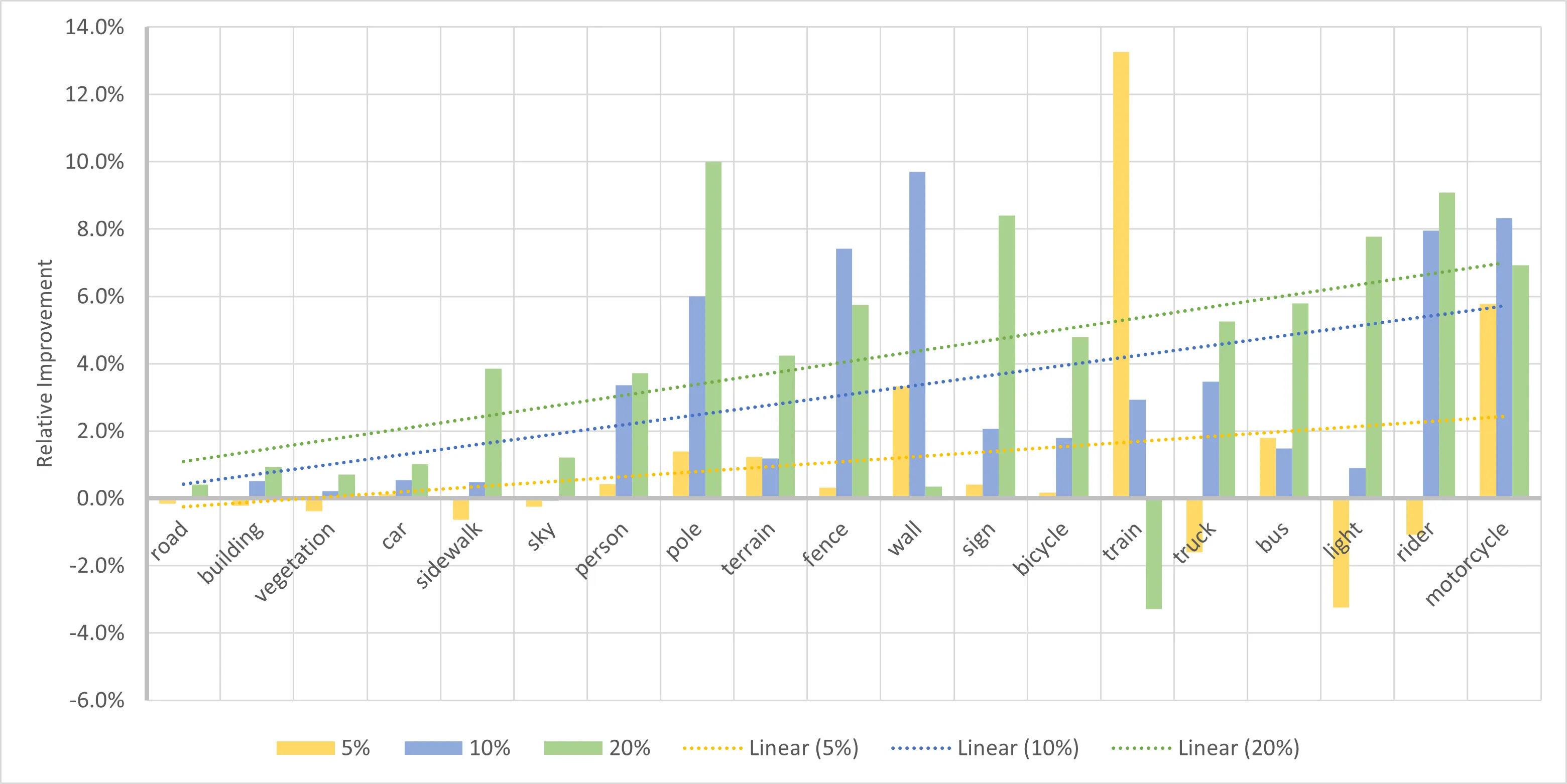
We evaluate DeepLabv3+ with a ResNet-101 backbone. For GTAV to Cityscapes, CBDA reaches 72.3, 72.2, and 71.2 mean IoU (mIoU) at 5%, 10%, and 20% labeling budgets. The corresponding RA reruns achieve 71.7, 70.5, and 68.8. Minimum class IoU improves by 0.5, 2.9, and 4.6 points. The 5% CBDA result also exceeds the fully supervised comparison's 71.8 mIoU in this evaluation.
Why balancing and dynamic allocation work together
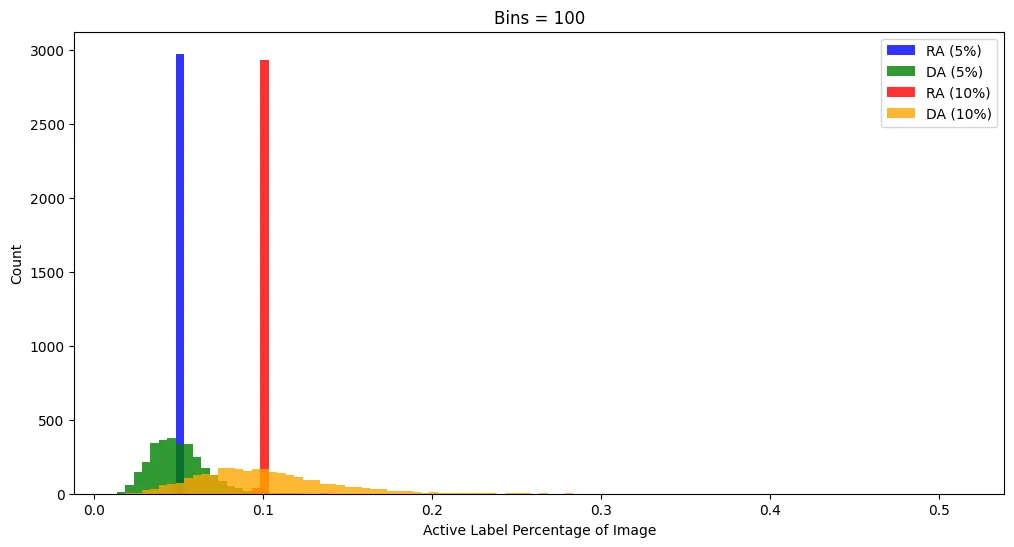
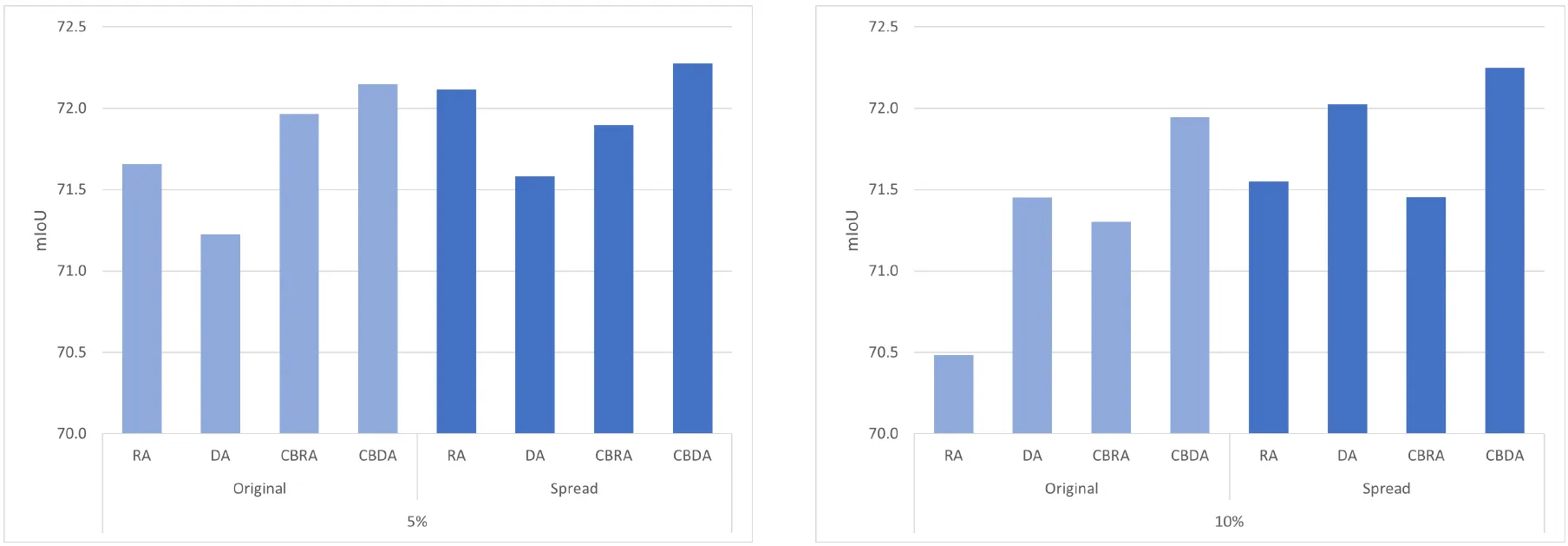
We compare RA, DA, class-balanced RA (CBRA), and CBDA at 5% and 10%. CBDA performs best in each displayed budget and acquisition schedule. DA alone underperforms RA at 5%, while spreading acquisition rounds further through training improves several configurations. These comparisons show typical runs, with greater run-to-run variability for DA alone.
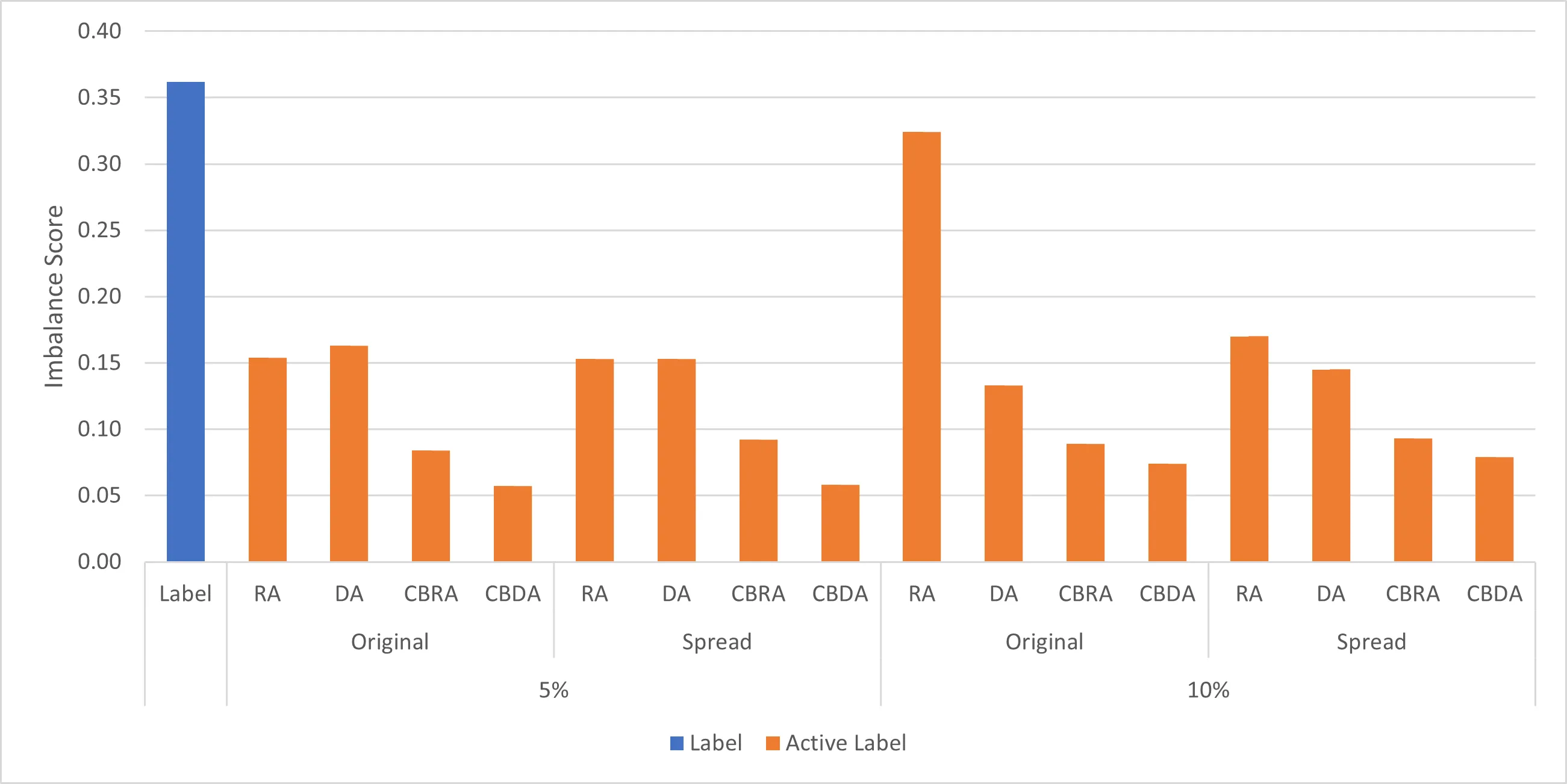
We quantify label imbalance through normalized KL divergence:
is the acquired class distribution, is uniform, and places all mass on one class. The score ranges from zero for uniform labels to one for single-class labels. CBDA's lower scores connect the acquisition rule to the intended balancing effect.
Dependence on source domain and labeling budget
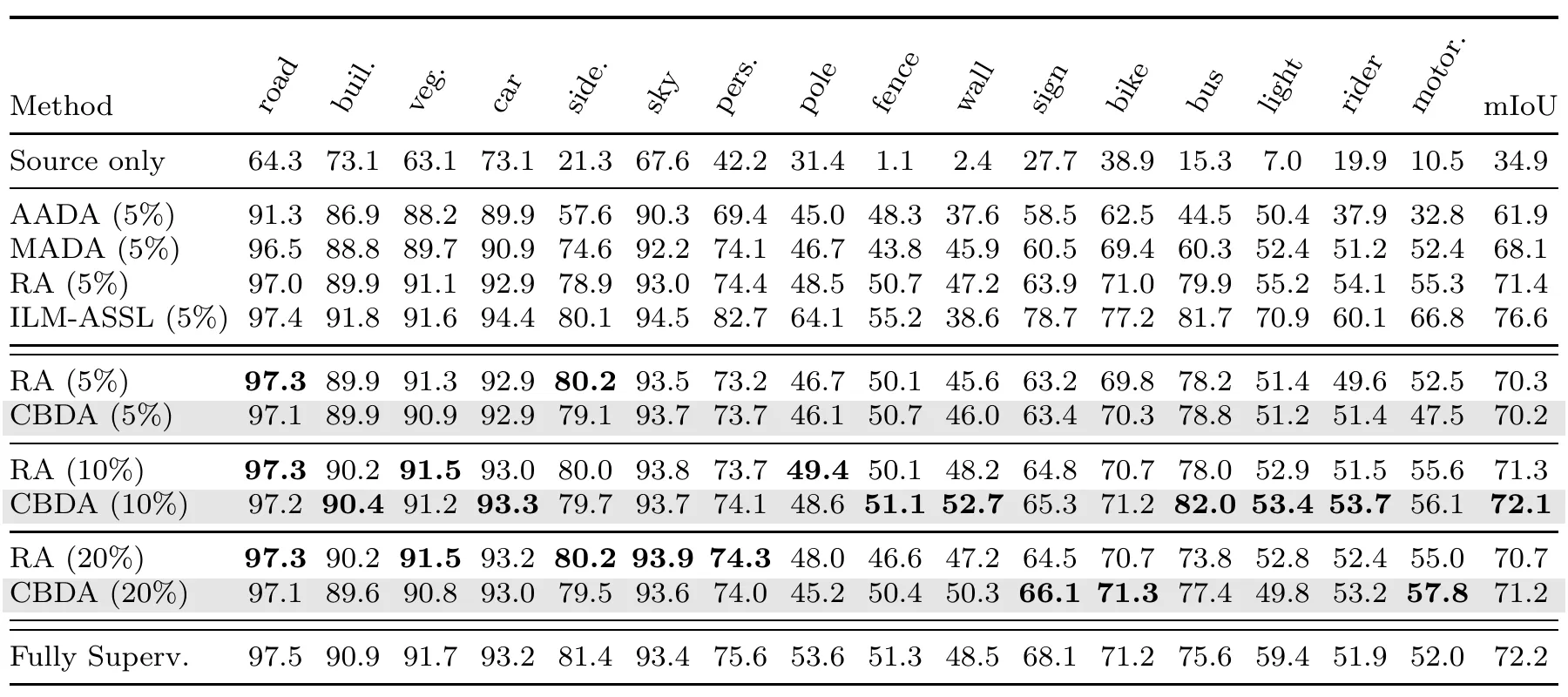
With SYNTHIA as the source, CBDA scores 70.2 versus RA's 70.3 mIoU at 5%, then improves by 0.8 and 0.5 points at 10% and 20%. The benefit varies with source domain and budget. For GTAV, both RA and CBDA lose performance as the budget increases, while CBDA reduces the size of this decline.
CBDA operates on pixel-acquisition scores, with RA supplying the scores in these experiments. The labeling budget counts sparse pixel queries whose ground-truth labels are revealed during acquisition. It measures the amount of supervision supplied to the model; annotation time also depends on the interface and the human labeling workflow.